

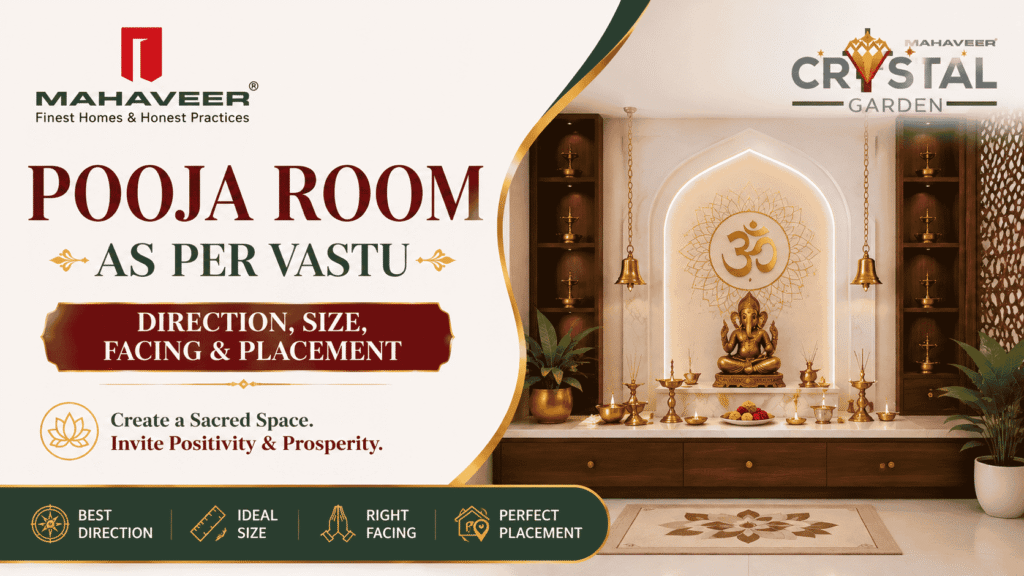
Pooja Room as per Vastu – Direction, Size, Facing & Placement
A pooja room is more than just a place for prayer it is a peaceful space where you can connect with your spiritual side and begin your day with positivity. Designing a pooja room as per vastu involves considering its direction, placement, size, idol orientation, lighting, and overall cleanliness.
Whether you live in an apartment, are planning a 3 BHK home, or are looking for a west facing house vastu plan with a pooja room, following traditional Vastu guidelines can help you create a calm and dedicated prayer space.
In this guide, we explain the best direction for a pooja room, ideal size, facing of God, and important Vastu considerations for east- and west-facing homes.
Pooja Room Direction as per Vastu
The direction of the pooja room is one of the most important considerations in traditional Vastu Shastra. The North-East (Ishanya) direction is generally considered the most suitable location for a pooja room because it is traditionally associated with spiritual energy and positivity.
If the North-East corner is not available, the following directions can also be considered:
- East direction
- North direction
- A clean and dedicated prayer space in a suitable area of the home
The pooja room should ideally be kept away from bathrooms, excessive clutter, and areas that may disturb the peaceful atmosphere of the prayer space.
For apartments and compact homes, a dedicated pooja corner can also be planned thoughtfully without requiring a large separate room.
What Is the Best Direction for Pooja Room as per Vastu?
The North-East is traditionally considered the best direction for a pooja room as per Vastu. This area, known as the Ishanya corner, is regarded as an auspicious zone for spiritual activities.
If the North-East area cannot be used, the East or North zones may be considered depending on the overall layout of the house.
When choosing the location, also consider
- Natural light and ventilation
- A clean and peaceful environment
- Easy access for family members
- Sufficient space for prayer and storage
- Distance from bathrooms and other unsuitable areas
The exact placement should also be considered along with the overall house layout rather than relying on direction alone.
Pooja Room Direction as per Vastu
Direction / Location | Vastu Preference | General Guidance |
North-East (Ishanya) | Most preferred | Traditionally considered the ideal direction for a pooja room |
East | Suitable alternative | Can be considered when the North-East is not practical |
North | Suitable alternative | May be considered depending on the overall house layout |
South | Generally avoided | Traditionally not preferred for the main pooja room |
Under staircase | Generally avoided | A dedicated and peaceful location is traditionally preferred |
Near bathroom | Avoid where possible | Keep the prayer space separate from bathrooms |
According to Vastu, Pooja Room Should Be in Which Direction?
A common question is: according to Vastu, pooja room should be in which direction?
Traditionally, the North-East direction is considered the first preference, followed by suitable areas in the East or North. The final choice can depend on the orientation and floor plan of the home.
For a modern apartment, it may not always be possible to create a separate pooja room in the exact preferred zone. In such cases, a clean, dedicated prayer area can be planned within the available space.
The goal should be to create a peaceful, uncluttered and comfortable place for prayer.
East-Facing House Pooja Room as per Vastu
An east-facing house pooja room as per Vastu can be planned by considering the overall layout and available zones of the home.
The North-East area remains a preferred location for the pooja room. If that area is not practical, the East zone may also be considered.
For an east-facing home, keep the pooja space:
- Clean and well-maintained
- Well ventilated where possible
- Away from bathrooms
- Free from unnecessary storage
- Comfortable for daily prayer
The placement of idols and the direction in which family members face while praying should also be considered as part of the overall arrangement.
West Facing House Vastu Plan with Pooja Room
A west-facing home can also have a thoughtfully planned pooja room. The direction in which the main entrance faces does not automatically determine the location of every room inside the house.
In a west facing house vastu plan with pooja room, the North-East zone can be considered for the prayer area. If that is not possible because of the floor plan, the East zone may be considered as an alternative.
While planning the pooja room in a west-facing home:
- Consider the North-East zone first.
- The East zone can be considered when the preferred area is unavailable.
- Keep the prayer area separate from bathrooms.
- Maintain cleanliness and good ventilation.
- Plan the idols and prayer-facing direction carefully.
- Avoid using the pooja space as general-purpose storage.
A west-facing house can therefore have a comfortable and dedicated pooja space when the overall floor plan is planned thoughtfully.
West Facing House Vastu Plan with Pooja Room for 3 BHK
In a west facing house vastu plan with pooja room 3 BHK, space planning becomes especially important because the home usually includes multiple bedrooms, living areas, bathrooms, kitchen and other functional spaces.
A practical approach is to identify the preferred North-East zone during the initial floor-plan stage and reserve a suitable area for prayer.
For a 3 BHK home, the pooja room can be
- A small dedicated room
- A compact prayer area
- A wall-mounted or built-in pooja unit
- A dedicated corner in a suitable living area
The size should be based on the available floor area and the family’s requirements. There is no need to make the pooja room unnecessarily large if a smaller, peaceful space can serve the purpose effectively.
Pooja Room Placement for East- and West-Facing Homes
House Type | Preferred Pooja Room Zone | Planning Consideration |
East-facing house | North-East | East zone may also be considered depending on the floor plan |
West-facing house | North-East | East zone can be considered if the North-East is not practical |
West-facing 3 BHK | North-East where practical | Plan the pooja space along with bedrooms, living areas and other rooms |
Apartment | North-East, East or North | A compact pooja corner or built-in unit can work well in limited space |
Facing of God in Pooja Room as per Vastu
The facing of God in a pooja room is another commonly discussed aspect of traditional Vastu.
According to traditional guidelines, the arrangement of idols should allow the person praying to face a suitable direction, commonly East or North. Idols should be positioned thoughtfully and should not be placed directly facing South.
Some commonly followed practices include:
- Keep idols arranged neatly.
- Avoid overcrowding the prayer space.
- Do not place broken or damaged idols.
- Maintain a comfortable distance between idols and the wall where practical.
- Keep the pooja area clean and well maintained.
The exact arrangement can vary depending on the size and design of the prayer space.
Small Pooja Room Size as per Vastu
A pooja room does not need to be large to create a peaceful prayer environment. For apartments and smaller homes, a compact pooja space can be designed effectively.
When considering small pooja room size as per Vastu, focus on proportion, cleanliness, accessibility and comfort rather than simply increasing the room dimensions.
For example:
- A compact 4 × 4 ft space can work for a small dedicated pooja room.
- A 5 × 7 ft space can provide more comfortable room for prayer and storage.
- A small pooja unit can be suitable when a separate room is not possible.
- Square or rectangular layouts are generally easier to plan.
- Avoid unnecessary clutter and excessive storage.
The ideal size ultimately depends on the overall floor plan, available space and requirements of the family.
Pooja Room Design and Interior Tips as per Vastu
Once the location and size are decided, the interior design can make the pooja room more comfortable and peaceful.
Lighting
Natural light and ventilation can make the space feel fresh and welcoming. Soft lighting can also create a calm atmosphere during prayer.
Colours
Light and soothing colours are commonly preferred for prayer spaces, including:
- White
- Cream
- Light yellow
- Light blue
The choice of colour should complement the overall interior design of the home.
Storage
Keep pooja-related items organized. Cabinets or drawers can be used to store frequently needed items without making the prayer area look cluttered.
Doors
If the pooja room is enclosed, a simple wooden door can complement the space. Double-shutter doors are also commonly used in traditional pooja room designs.
Things to Avoid in a Pooja Room as per Vastu
Maintaining cleanliness and organization is important for a peaceful prayer environment.
Commonly followed Vastu practices include avoiding:
- Broken or damaged idols
- Damaged religious photographs
- Excessive clutter
- Unnecessary storage
- A pooja room directly adjoining a bathroom
- Using the prayer space as a general storage area
- Poor ventilation and excessive darkness
A clean and organized pooja room can make daily prayer more comfortable and create a serene atmosphere within the home.
Pooja Room Vastu for Apartments and Modern Homes
Modern apartments often have limited space, making it difficult to create a large dedicated pooja room. However, Vastu principles can still be considered during the planning stage.
If you are exploring thoughtfully planned apartments in Attapur, you can also explore Mahaveer Crystal Garden, a premium residential project designed for modern family living.
Depending on the floor plan, homeowners can choose:
- A dedicated pooja room
- A compact pooja corner
- A built-in pooja unit
- A partitioned prayer area
The North-East, East or North zones may be considered according to the available layout.
Instead of forcing a large prayer room into an unsuitable location, it is better to create a practical and peaceful space that works naturally with the home’s design.
How to Plan a Vastu-Friendly Home with a Pooja Room
When building or buying a home, consider the pooja room along with the complete floor plan rather than treating it as an isolated feature.
Important points to check include
- Overall house orientation
- North-East zone
- Location of bedrooms and bathrooms
- Pooja room accessibility
- Natural lighting
- Ventilation
- Available space
- Storage requirements
Whether you are planning an east-facing home or a west facing house vastu plan with pooja room, the complete layout should be considered before finalizing the prayer space.
Conclusion
Designing a pooja room as per vastu is about creating a dedicated and peaceful environment for prayer and reflection. The North-East is traditionally considered the preferred direction, while East and North may also be considered depending on the home’s floor plan.
Whether you are choosing the best direction for a pooja room, planning a small pooja room size as per vastu, deciding the facing of God in the pooja room, or developing a west facing house vastu plan with pooja room, thoughtful planning can help create a comfortable and harmonious prayer space.
For modern homes and apartments, practical space planning is equally important. A well-designed pooja area can become a meaningful part of the home while complementing its overall architecture and interior design.
FAQ’s About Pooja Room as per Vastu
1. What is the best direction for a pooja room as per Vastu?
The North-East direction is traditionally considered the best direction for a pooja room. East and North may also be considered depending on the overall house layout.
2. As per Vastu, the pooja room should be in which direction?
As per traditional Vastu guidelines, the North-East is generally preferred for a pooja room. If it is unavailable, East or North may be considered based on the floor plan.
3. According to Vastu, pooja room should be in which direction for a west-facing house?
A west-facing house can have the pooja room in the North-East zone where practical. The East zone may also be considered depending on the layout.
4. What is the ideal small pooja room size as per Vastu?
A compact pooja room can be around 4 × 4 ft, while a 5 × 7 ft space can provide more room for comfortable prayer and storage. The ideal size depends on the overall home layout.
5. Which direction should God face in a pooja room?
According to commonly followed traditional guidelines, idols may be arranged so that the person praying can face East or North. Avoid positioning idols directly facing South.
6. Can an east-facing house have a pooja room in the East direction?
Yes. An east-facing house can have a pooja space in the East zone depending on the complete floor plan. The North-East area is traditionally given priority where practical.
7. Can a west-facing house have a pooja room?
Yes. A west-facing house can have a dedicated pooja room. The North-East zone is generally preferred, while other suitable areas can be considered based on the home’s layout.
8. Can I have a pooja room in a 3 BHK apartment?
Yes. A 3 BHK apartment can include either a dedicated pooja room or a compact prayer area depending on the available floor space and layout.
9. Can a small apartment have a pooja room as per Vastu?
Yes. A separate large room is not always necessary. A compact and dedicated pooja unit or prayer corner can be planned thoughtfully within the available space.
10. What should be avoided in a pooja room?
Broken idols, excessive clutter, poor maintenance and placing the prayer space in unsuitable areas should generally be avoided. Keeping the space clean and peaceful is important.
11. Can a pooja room be placed in the North direction as per Vastu?
Yes. If the North-East area is not available, the North direction may be considered for a pooja room depending on the overall house layout.
12. Can the pooja room be placed in the East direction?
Yes. The East direction can be considered for a pooja room, particularly when the North-East area is not practical. The space should be clean, peaceful and properly maintained.
13. Can a pooja room be inside the living room?
Yes. In apartments and compact homes, a dedicated pooja corner or built-in prayer unit can be incorporated into the living room. It is better to keep the area visually separate and free from clutter.
14. Can we have a pooja room under a staircase?
A pooja room under a staircase is generally avoided in traditional Vastu practices. If possible, choose a more suitable and peaceful location for the prayer space.
15. Can the pooja room be next to a bathroom?
It is generally recommended to avoid placing the pooja room directly next to or sharing a wall with a bathroom where possible. A separate and clean prayer space is traditionally preferred.
16. What shape should a pooja room be as per Vastu?
A square or rectangular pooja room is generally preferred because it provides a simple and balanced layout. Irregularly shaped spaces can be more difficult to plan effectively.
17. Should a pooja room have a door?
A separate pooja room can have a door, especially when the space is designed as an enclosed prayer area. In smaller homes, an open or partitioned pooja unit can also be a practical option.
18. Can a pooja room be placed in a bedroom?
A dedicated pooja room is generally preferred over placing the prayer area inside a bedroom. However, when space is limited, a compact and thoughtfully separated prayer unit may be considered.
19. How should idols be arranged in a small pooja room?
In a small pooja room, idols should be arranged neatly without overcrowding the space. Keep sufficient room for prayer and ensure that the area remains clean and easy to maintain.
20. Is natural light important for a pooja room as per Vastu?
Natural light and ventilation can help create a fresh and peaceful environment. Where natural light is limited, suitable artificial lighting can be used to keep the pooja area bright and comfortable.